
ChemRxiv Opens Doors to LENRs
By Steven B. Krivit
Dec. 12, 2025
Benjamin Mudrak, the senior product manager for the ChemRxiv chemistry preprint server, has informed me that ChemRxiv will be more receptive than it had been to manuscripts on low-energy nuclear reaction (LENR) research.
“It does appear that more recent investigations and analyses have presented some scientific data and rationale for low-energy nuclear reactions,” Mudrak wrote. “We would be happy to receive and consider future work on the subject that fits one of our manuscript types. If supported by peer-reviewed research and new research data, full-length research manuscripts or comprehensive reviews on any subject related to chemistry are within scope.”
This development followed a letter I sent to members of the ChemRxiv scientific advisory board, pointing out the organization’s practice of rejecting LENR papers. I also provided Mudrak a copy of my recent paper written with Michael Ravnitzky, “Review of Condensed-Matter Nucleosynthesis.” The paper lays out a credible scientific foundation for LENRs — as genuine nuclear effects — but does not assert a “cold fusion” mechanism. I asked whether it was time for a change at ChemRxiv.
I was motivated to contact ChemRxiv because electrochemist Melvin Miles died on Oct. 20, 2025. He was 88. He was among the scientists ChemRxiv had excluded. I had the pleasure of knowing and speaking often with Miles for the past 25 years. He struggled to understand the difficult experimental results he had seen firsthand and to publish his results.
Despite declining physical health, he worked hard to communicate his research to the scientific community until his final moments. In 2023, I had the great privilege of co-authoring a paper with him. We submitted a preprint of our paper to the ChemRxiv server at that time.
The ChemRxiv website explains that its staff performs a basic screening process but does not conduct peer review. It also states that it does not publish preprints that are “non-scientific.”
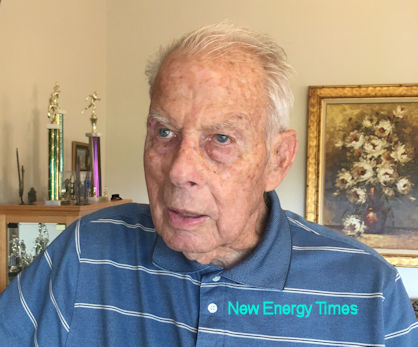
Melvin Miles, 2024 (Photo: S. Krivit)
The ChemRxiv website lists many benefits it provides to researchers. Miles and I were hoping that ChemRxiv could help us establish the priority of what we were reporting. We also hoped that our preprint would give us the opportunity to receive broad, informal critique from the scientific community before journal submission. We wanted our preprint available in an open-access draft for readers who might later be unable to access a paywalled version of our paper.
ChemRxiv declined to allow our paper onto its server.
Pencil and Paper
Miles and I overcame significant difficulties while writing our paper. I did not have the skills to follow longhand mathematical calculations. He did not have the skills to use electronic spreadsheet software. From Utah, he wrote out his equations and tables with pencil and paper, photographed them, and emailed them to me in California. I sent him back images of my spreadsheets. We went back and forth until we arrived at a mutual understanding. It was a creative mode of collaboration.
Miles and I also had other differences. Although we agreed on the experimental nature of the research that interested us, we strongly disagreed on theory. He firmly believed that deuterium nuclei can overcome the Coulomb barrier at high rates at room temperature. This is the fundamental hypothesis of nearly all “cold fusion” theories. He believed this explained the excess heat and helium-4 he had personally observed.
I, on the other hand, believe that fusion has little to do with the experimentally observed phenomena. I think they are rooted instead in neutron-based electroweak interactions. That’s why, in 2008, I began calling this research low-energy nuclear reactions (LENRs). A few years ago, Miles and I argued intensely about our theoretical differences.
But we argued respectfully, and that allowed us to collaborate effectively on the experimental matters where we did agree. From this foundation, we analyzed a historically important scientific discrepancy, co-authored a paper, and corrected the scientific record.
Journal of Electrochemistry Publishes
Although ChemRxiv blocked our preprint, an editor with the Journal of Electrochemistry, the official journal of the Chinese Society of Electrochemistry, gave us a fair chance. Our paper passed peer review (https://doi.org/10.61558/2993-074X.3424) and sheds new light on a 36-year-old error that derailed progress in this field. The potential significance of this research includes the possibility of a new source of abundant, carbon-free energy.
Journal of Electroanalytical Chemistry Publishes
Miles later worked on another paper. Again, ChemRxiv blocked his preprint from the server.
However, an editor with Elsevier’s Journal of Electroanalytical Chemistry gave Miles and his co-author Peter Hagelstein a fair chance. The paper passed peer review and was published. (https://doi.org/10.1016/j.jelechem.2024.118786)
Agree to Disagree
I disagree with Miles’ interpretation of fusion, but I unequivocally support his right to publish and the essential role of scientific communication. Science is inherently self-correcting, but progress is achieved through communication rather than suppression.
As far as I know, this was the last paper Miles published before his death. Despite our divergence of opinion on theory, he was always kind and courteous. It was an honor to know him and to work with him, and it will be an honor to help preserve and share more about his role in science history.
