Feb 062012
 

Click Here for the Summary Report/Conclusion 

Mitchell Swartz, a longtime low-energy nuclear reaction researcher, has complained about three minor details in recent articles in New Energy Times about his claims.

Swartz’s Feb. 5 complaints appeared on his Web site, “Cold Fusion Times.” He was responding to articles we published on Feb. 3 and on Feb. 4.

In addition to being a LENR researcher, Swartz claims that he is also a LENR journalist and that his Web site is a journal, periodical and newsletter that covers the field of “cold fusion.”

Our articles were about a “significant energy gain” that Swartz publicized about his own work earlier in the week. His news spread across the Internet.

First, we stated that his “significant energy gain” was 18 milliwatts when, in fact, it was 80 milliwatts.

Second, we stated that his “significant energy gain” was by a factor of 10 when, in fact, it was, according to Swartz, “just above about 14.”

Third, we stated that his “significant energy gain” lasted for only three minutes when, in fact, according to Swartz, “it actually performed for that part of its weeklong performance for circa 4 x (3,592-2,053) seconds!!!”

When Swartz first publicized his claim, he failed to disclose to his readers that his “significant energy gain” was a mere 80 milliwatts and that it lasted for “4 x (3,592-2,053) seconds.”

In the past year, the publicity in the field has been dominated by Andrea Rossi’s dubious claims of excess-heat output on the order of a megawatt. Swartz has been one of Rossi’s biggest supporters. Swartz’s excess heat output, however, was 10 million times less, but he didn’t disclose that on Feb. 3.

In his response, Swartz did not mention anything about why he failed to disclose the magnitude or duration of his “significant energy gain.”

Even though Swartz’s complaints are about minor details, we do pride ourselves on getting the facts straight and the data accurate.

Swartz had not published any data or reports until Feb. 5. Normally, scientists publicize their claims along with or after publishing their data and scientific evidence. Swartz did not do this. We e-mailed Swartz on Feb. 3 to learn more about his experiment and his results. He did not respond. This made it difficult to understand his results and to confirm the facts.

A LENR researcher contacted us on Feb. 4 and advised us about the 18-milliwatt error. We published that correction immediately.

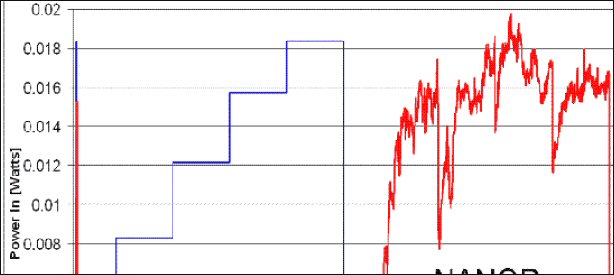
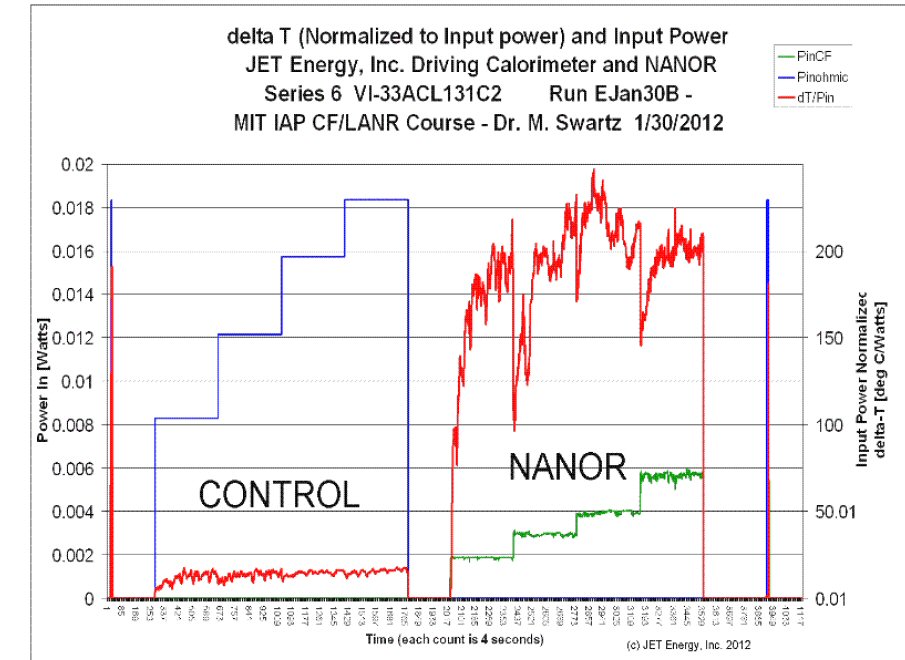
Only after Swartz published his data on Feb. 5 did we realize why the first researcher had difficulty understanding Swartz’s slide and mistook 18 for 80. Take a look at the detail from Swartz’s slide #2 of his Jan. 30 experiment below.

The y-axis label says “Power In [Watts],” and the red curve reaches just beyond 0.018. It would have been better if Swartz labeled this as “Power Input in Watts” or even “Power Input [Watts].” Because of Swartz’s poor labeling, the researcher thought he was looking at the excess-heat power, in Watts, rather than input power, in Watts.

(Click here for full slide)

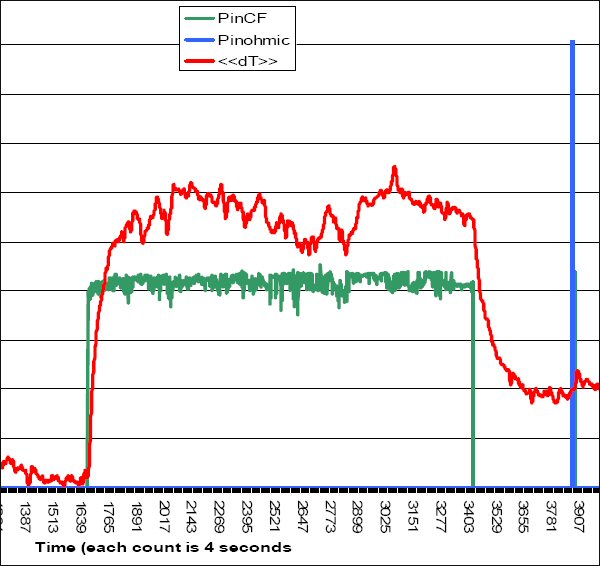
The second researcher thought that the duration of the excess heat lasted three minutes, and we reported this. As Swartz has written in his response, the duration of the “significant energy gain” was “4 x (3,592-2,053) seconds.” Apparently, the second researcher had difficulty understanding Swartz’s timescale. Here is a snapshot:

Swartz wrote that we made a mistake by writing that he had an energy gain of 10. The mistake is his. We obtained the value of “10” from his Web site on Feb. 3.

As he stated on Feb. 5, Swartz elected to release his data and charts on his Web site only after we published our news stories.

Feb 042012
 

Click Here for the Summary Report/Conclusion

Yesterday, New Energy Times reported that Wellesley Hills, Mass., low-energy nuclear reactions researcher Mitchell Swartz made a misleading claim on his personal Web site.

“This JET Energy NANOR(TM) demonstrated a significant energy gain greater than 10,” Swartz wrote.

New Energy Times had received a tip from a LENR researcher that the gain was 18 milliwatts.

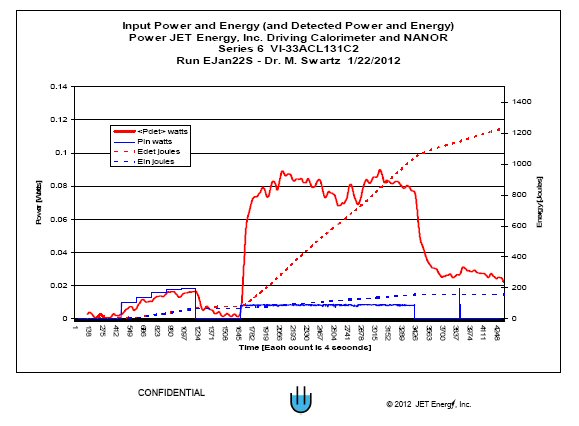
Today, another LENR researcher provided us with Swartz’s data. The first researcher was off, but not by much. It was 80 milliwatts, not 18.

When Swartz published his claim on his Web site, he failed to tell readers – many of whom are new to LENR – that his claim was in milliwatts. This was a crucial omission because, for the past year, most of the news in LENR has been dominated by the extraordinary claims of “Energy Catalyzer” inventor Andrea Rossi, who has made claims in megawatts.

Less significant, but still important, was that Swartz failed to tell readers that the excess-heat period ran for only three minutes.

Swartz’s results are no different from thousands of other LENR experiments in the last 23 years. A LENR researcher who requested anonymity was surprised that Swartz would report this as a significant result.

“There are three graphs,” the researcher wrote. “The third one is the only understandable one. Swartz’s demonstration was showing an efficiency of 10, which sounds good, but his peak power output is only 80 milliwatts! That’s right: MILLIWATTS!

“In 23 years, he has yet to sustain anything more than 1 watt. There is little in Swartz’s work to get excited about.”

The second researcher, who provided Swartz’s slides today, wrote this comment to me in an e-mail:

“When you look at the data, you can see, barely, a 1 degree C temperature rise for about three minutes, using about 12 mW of input power to produce less than 100 milliwatts of heat. This is not a breakthrough.”

(Click here for larger image)

Swartz bypassed scientific protocol when he announced his claim on his Web site. Had he followed proper scientific communication protocol, as most LENR researchers do, he would have been required to provide at least the following:

1. Maximum excess-heat power level.
2. Percent of excess heat relative to input power.
3. Duration of excess-heat period or excess energy.

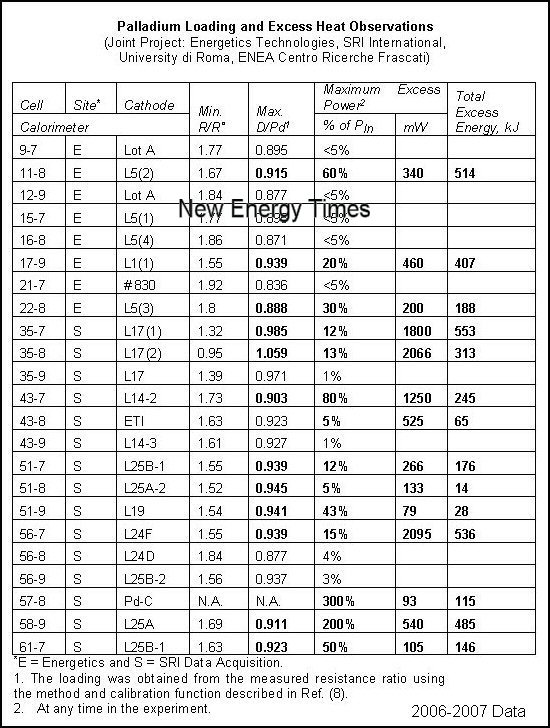
A good example of well-described excess heat results is SRI International electrochemist Michael McKubre’s graph on page 227 of the American Chemical Society “Low-Energy Nuclear Reactions Sourcebook.”

Table Courtesy M. McKubre. Source: McKubre, M.C.H., Tanzella, F.L., Dardik, I., El Boher, A., Zilov, T., Greenspan, E., Sibilia, C. and Violante, V., “Replication of Condensed Matter Heat Production,” Low-Energy Nuclear Reactions Sourcebook, Marwan, Jan, and Krivit, Steven B., eds., American Chemical Society/Oxford University Press, Washington, D.C.,ISBN 978-0-8412-6966-8, August 2008

Feb 032012
 

Click Here for the Summary Report/Conclusion

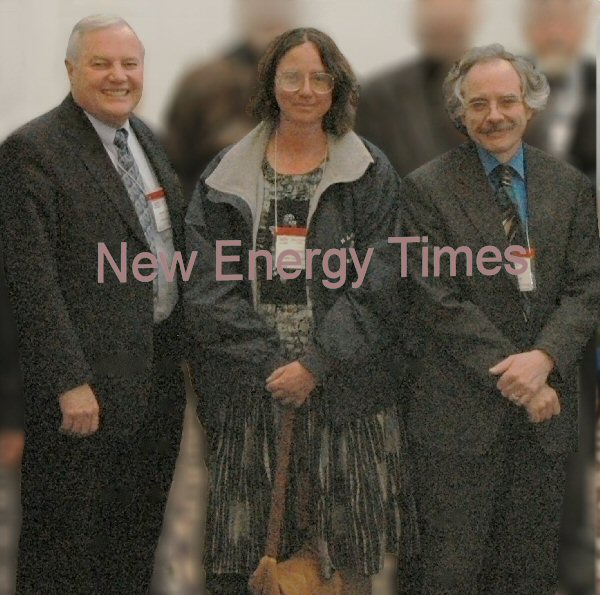
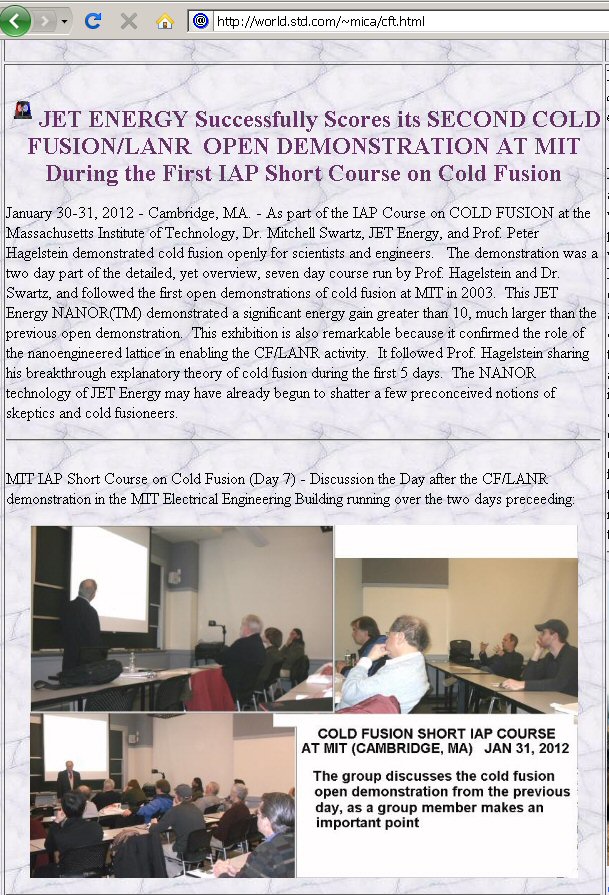
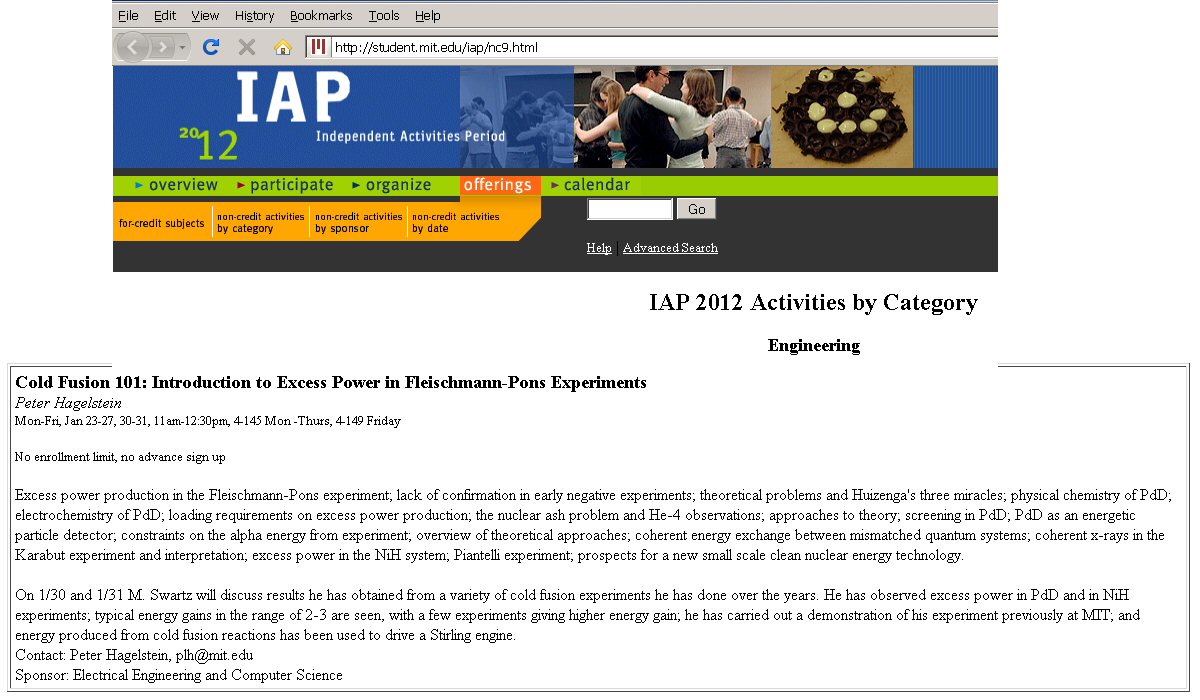
Mitchell Swartz, a longtime low-energy nuclear reaction researcher, claimed on his Web site that he and Peter Hagelstein, an associate professor of electrical engineering at the Massachusetts Institute of Technology, performed a LENR excess-heat experiment as part of a “course on cold fusion at the Massachusetts Institute of Technology.”


Mitchell Swartz

They claimed a heat output 10 times greater than the electrical power input.

“This JET Energy NANOR(TM) demonstrated a significant energy gain greater than 10,” Swartz wrote, “much larger than the previous open demonstration. This exhibition is also remarkable because it confirmed the role of the nanoengineered lattice in enabling the CF/LANR activity.”

However, Swartz did not reveal the power level of this demonstration. Another LENR researcher did.

The researcher, who learned about the demonstration from Swartz, told New Energy Times that the peak power output Swartz measured in that experiment was 18 milliWatts.

In his news article, Swartz did not provide any reference to a scientific paper or more data.

New Energy Times invited Swartz to comment by e-mail earlier today, but we did not receive a response.

Swartz bypassed scientific protocol when he announced his claim on his Web site before publishing a paper. Other LENR researchers have been more sensitive to scientific protocol, announcing their findings only after submitting their work to peer-reviewed journals, mainstream science conferences or mainstream scientific encyclopedias.

Jan 312012
 

In 2010, New Energy Times began an investigation into SRI International electrochemist Michael McKubre’s experiment “M4.” In the preceding decade, McKubre had presented this experiment as the best proof for “cold fusion.”

In our investigation, we found that McKubre gradually changed, added and deleted data points and values in “M4.” McKubre made all these changes without scientific explanation, most without notification.

McKubre is one of the most qualified electrochemists who has worked in the field of low-energy nuclear reactions. He and his former group set the standard in the 1990s for precision measurement of excess heat in LENR experiments. They designed first-principles calorimeters and performed meticulous, temporally correlated measurements of helium production in LENR cells.

Click here to go to index

Jan 242012
 

Andrea Rossi, an Italian man who claims to have invented a practical low-energy nuclear reaction device, will not have his device tested and evaluated by the University of Bologna.

Last summer, Rossi said he had started a research contract with the university to allow its researchers to study his “Energy Catalyzer.” But that didn’t happen.

Today, Dario Braga, director of scientific research at the university, told New Energy Times that the university waited long enough. It terminated the contract because Rossi did not fulfill his agreement to make the first progress payment, Braga said.

“The contract ended on January 15 and has been canceled by the university,” Braga said. “Therefore, there is no further relationship between the university and Rossi or his company.”

In October, Rossi claimed that he sold a device to an unidentified customer, but there is no factual evidence to support this. Rossi’s failure to make a payment to the university casts doubt on the sale.

Throughout 2011, Rossi devised secretive and increasingly elaborate “E-Cats” that he claimed were producing high levels – in fact commercially viable levels – of excess heat. He arranged several press conferences and paid for invited foreign professors to visit.

But the tests were never long enough, the data was always poor and the devices were always too complicated to allow a definitive conclusion in Rossi’s favor. Regardless, Rossi captured the hearts and goodwill of fans and believers worldwide.

Technology journalist Mats Lewan reported in Ny Teknik on March 10, 2011, that Rossi “is now paying 500,000 Euros to the Physics Department of Bologna University, following a new agreement.”

But Rossi apparently lied to his fans last March about the university contract. No contract was signed in March. Paolo Capiluppi, the head of the University of Bologna Physics Department, signed the contract at the end of May, and Rossi signed it on June 21, 2011.

Hanno Essén, a lecturer at the Swedish Royal Institute of Technology who was paid by Rossi to come to Bologna to evaluate his device, told New Energy Times on July 15, 2011, how he thought Rossi was planning to pay for the university research.

“According to what I heard,” Essén said, “the University of Bologna contract will become active in late October, because then Rossi will get money from Athens, but this is only speculation. According to the schedule I heard, nothing will happen until October.”

But the Greek connection, Defkalion, fizzled long before October. Defkalion failed to make its first scheduled payment to Rossi on Aug. 1. The following week, Rossi made a connection with an American investor, John Preston of Quantum Energy Technologies, but that fizzled, too.

Rossi met with Preston Aug. 2-4 in Boston and drew up an agreement and defined test parameters. On Rossi’s invitation, Preston and his colleagues went to see and test Rossi’s device on Sept. 5 and 6. But it didn’t work, and they left.

On Oct. 7, a month after Preston walked away, Ny Teknik reported that Rossi canceled the agreement with Preston.

“We had a preliminary agreement with a very important party in the U.S.,” Rossi said, “but when we received the final draft, it included conditions that our lawyers said that we should not accept.”

http://newenergytimes.com/v2/sr/RossiECat/img/20110900Preston-Visit-To-Rossi.jpg
September 2011 photo outside Rossi’s showroom. Left to right: unidentified, Andrea Rossi, Sergio Focardi, John Preston. Photo courtesy Jim Dunn.

© 2025 newenergytimes.net