Feb 102012
 

New Energy Times Report #4: Rossi’s NASA Test Fails to Launch
Feb. 10, 2012
By Steven B. Krivit
Editor, New Energy Times

[The full New Energy Times article is Copyright 2012 New Energy Times and may not be reproduced without permission. The Background Facts and Synopsis are Copyleft 2012 New Energy Times. Permission is granted to reproduce the Background Facts and Synopsis as long as they, this notice and the publication information are included in their entirety and no changes are made to the text.]

Background Facts on LENRs
– Low-energy nuclear reactions are represented by a significant body of research that has been published in mainstream peer-reviewed journals, presented at mainstream conferences and printed in mainstream scientific encyclopedias. Click on “About LENRs” from the New Energy Times menu.
New Energy Times performed extensive reporting and videotaped documentation on the Rossi “Energy Catalyzer” topic in 2011. Click on “Andrea Rossi’s E-Cat” from the New Energy Times Investigations menu.
– Rossi is not the first person to attempt to commercialize LENR. People have made such efforts throughout the history of the field. Click on “Commercial Index” from the New Energy Times left-hand menu.

Synopsis of Report #4: Rossi’s NASA Failures
Andrea Rossi, an Italian man who claims to have invented a practical low-energy nuclear reaction device, will not have his device tested and evaluated by NASA. In the past year, Rossi has had mixed success in gaining support at two NASA laboratories: Langley Research Center in Hampton, Va., and Marshall Space Flight Center in Huntsville, Ala.

On July 14, 2011, Rossi asked staff members at NASA Marshall to test and evaluate his device. Marshall staff accepted Rossi’s offer. The two parties began negotiating details of the test protocol. NASA asked for a test that avoided phase change of water into steam because steam would introduce unnecessary confusion to the test. A few days later, Rossi withdrew his offer.

New Energy Times obtained this story as it took place; however, in an agreement with NASA, New Energy Times agreed to embargo the story until 2012.

On Sept. 5 and 6, a private demonstration of Rossi’s device in Bologna, Italy, took place before a group of visitors: Jim Dunn, the former director of the NASA Northeast Regional Technology Transfer Center and a close associate of Dennis Bushnell, the chief scientist at NASA Langley; John Preston, a Boston investor; and at least one technical expert. The objective of this demonstration was to perform basic due diligence that, if passed, would lead to a second chance at a full-fledged test by NASA.

Despite the team’s best efforts, its members were not able to confirm any excess heat from Rossi’s device. The demonstrations on Sept. 5 and 6 both failed.

A distinctive part of this story is the difference between the attitudes of two key NASA staff members who have been involved – one at Marshall, the other at Langley. Both people have been enthusiastic about LENR and recognize its potential as a game-changer in the areas of energy and technology. Both know the 23-year history of real science that distinguishes LENR from “free energy” and from “cold fusion.”

Dennis Bushnell, the chief scientist at Langley, has been a strong believer in Rossi and his “Energy Catalyzer” and has been publicly and uncritically promoting Rossi.

Michael A. Nelson, an engineer at Marshall who investigates low-energy nuclear reactions and space applications, has been more circumspect. Nelson has publicly identified the key technical concerns about the Rossi device.

Continue to Full Story

Feb 092012
 

In the last few years, New Energy Times has focused a lot of attention on the Widom-Larsen theory of low-energy nuclear reactions. In fact, there are at least 66 recognized theories of LENRs.

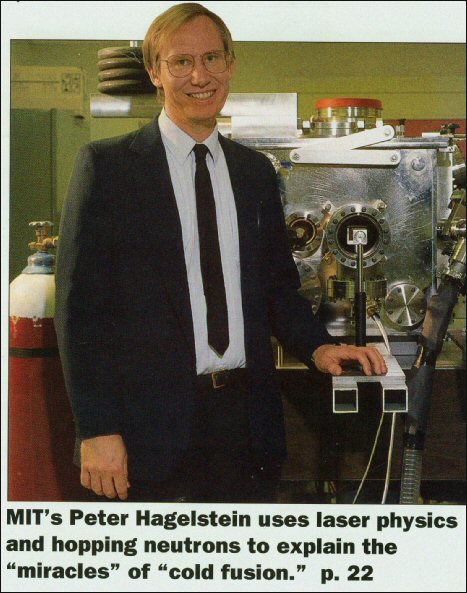
We have decided to look closely at the ideas of another theorist, Peter Hagelstein, an associate professor of electrical engineering at the Massachusetts Institute of Technology.

http://newenergytimes.com/v2/images/HagelsteinColdFusionMagExcerpt-CreditJohnFCook.jpg

Peter Hagelstein - Photo courtesy Cold Fusion Magazine/John F. Cook

Hagelstein began his work in response to the March 23, 1989, announcement by electrochemists Stanley Pons and Martin Fleischmann at the University of Utah. Pons and Fleischmann who claimed that they had made nuclear fusion in a tabletop experiment, to which news media applied the term “cold fusion.”

Within days, Hagelstein began working on a theory to explain “cold fusion.”

On April 12, 1989, according to the New York Times, MIT applied for “cold fusion” patents based on Hagelstein’s work. The Times reported that Hagelstein also submitted to scientific journals four papers outlining his theory.

By 2005, Hagelstein had made more than 150 attempts at a theory.

On Oct. 11, 2011, SRI International electrochemist Michael McKubre spoke at SRI’s Cafe Scientifique. McKubre discussed many low-energy nuclear reaction topics, including theory.

“The problem is that there are 500 theories,” he said, “all of them mutually contradictory, but the best theory that I’m aware of is my friend Peter Hagelstein’s at MIT.”

Prompted by McKubre’s confidence in Hagelstein’s ideas, New Energy Times has begun to review Hagelstein’s theoretical ideas and his progress.

Yesterday, New Energy Times sent an e-mail to McKubre and asked him why he thought Hagelstein’s “theory” is the best. McKubre did not respond.

In the past few months, New Energy Times has obtained copies of every theory paper Hagelstein has presented in the International Conference on Cold Fusion series. Hagelstein did not present a paper at the most recent (ICCF-16) conference.

In the past few days, we attempted to contact Hagelstein several times by e-mail and phone. He did not respond.

Readers may wish to begin learning about Hagelstein’s theoretical ideas from our Hagelstein Theory Portal.

To be continued.

Feb 082012
 

By Steven B. Krivit

[This article is Copyleft 2012 New Energy Times. Permission is granted to reproduce this article as long as this notice and the publication information are included in their entirety and no changes are made to the text.]

One of the most well-established nuclear physics institutions in the world, CERN, the European Centre for Nuclear Research, will host a colloquium on low-energy nuclear reaction research in March.

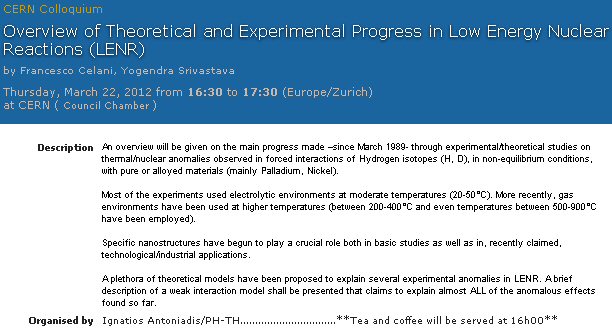
A general colloquium, “Overview of Theoretical and Experimental Progress in Low-Energy Nuclear Reactions (LENR),” will take place at CERN on March 22, from 4:30 p.m. to 5:30 p.m. in the council chamber.

http://newenergytimes.com/v2/news/2012/20120208CERN-March22-Colloquim-thumb.jpg

(Click here for larger image or for a text version of the announcement.)

The colloquium will review recent gas-environment LENR experiments and the role of nanostructures in the basic studies. Francesco Celani, a physicist with the Italian National Institute of Nuclear Physics in Frascati, Italy, will present this work.

The colloquium will also review the potential of one theory, the Widom-Larsen model of LENRs, which is based on weak interactions and neutron-capture processes. A co-author of the theory, Yogendra Srivastava, a physicist with the University of Perugia, Italy, will present this talk.

“A plethora of theoretical models have been proposed to explain several experimental anomalies in LENR,” the CERN announcement stated. “A brief description of a weak-interaction model shall be presented that claims to explain almost ALL of the anomalous effects found so far.”

Historically, CERN has been skeptical about LENR, though this was during a time when many proponents of the field believed the phenomena were explained as some kind of “cold fusion” and the body of experimental evidence was poorly understood.

Beginning in 1989 and for the next decade, Douglas R.O. Morrison, a physicist at CERN, published a regular series of newsletters that depicted the experimental work as well as the “cold fusion” theories as pathological science.

Click here for more information about gas-environment LENR experiments.
Click here for more information about the Widom-Larsen theory of LENRs.
Click here to learn more about low-energy nuclear reactions.

Feb 082012
 

The future of low-energy nuclear reaction research at the Navy’s Space and Naval Warfare Systems Center in San Diego, Calif., is at risk.

New Energy Times recently learned that a November 2011 story written by journalist John Brandon, published by Fox News, has led to potentially serious problems for this research group. The story was about Andrea Rossi’s “Energy Catalyzer” and suggested that it could be a “complete hoax.” We are still trying to learn more about the SPAWAR situation and will report details as soon as we can.

Throughout the last 23 years, a small team of low-energy nuclear reactions researchers at the SPAWAR lab, and recently in association with researchers from JWK International, a private company in Annandale, Va., has demonstrated some of the best experimental research in the LENR research field. The group has an impressive collection of published research and successful results in LENRs, far more than any other government lab, including the Naval Research Laboratory in Washington, D.C. Two members of the SPAWAR group have retired in the last few years.

Frank Gordon (SPAWAR, retired), Pamela-Mosier Boss (SPAWAR), Larry Forsley (JWK) at 2007 American Physical Society Meeting Photo: S.B. Krivit

Yesterday, New Energy Times obtained a document with an updated listing of the group’s peer-reviewed work in LENRs, and we revised our index of its work on the New Energy Times Web site.

The document also contains a synopsis of the group’s work. An excerpt is shown below. Click here for the full document.

“Scientists at the U.S. Navy SPAWAR Systems Center-Pacific (SSC-Pacific), and its predecessors, in conjunction with JWK International Corporation, have had extraordinary success in publishing LENR papers in peer-reviewed journals. This success hasn’t come easily and is due to several factors. One key reason was the courage of the SSC-Pacific upper management for twenty years in allowing scientists to conduct research and publish results in a controversial field. The few journal editors who had the fortitude to consider our work also contributed to this success. The reviewers also played a role in publishing our LENR-related papers. A multitude of reviewers, many outside the LENR field, had to put aside their biases and look objectively at our data. In turn, the reviewers’ relentless concerns forced us to tenaciously address their issues.

“As early as 1991, we began exploring nuclear effects, beginning with x-ray film and later measuring tritium, then on to charged particles and neutrons using solid-state nuclear track detectors. We have also performed thermal imaging, and a colleague carried out calorimetry. He found that the Pd/D co-deposition surface exceeds the energy performance of bulk Pd cathodes. Subsequent papers examined elemental transmutation, effects of external fields, and measurements of fast neutron energy and their source. The majority of our work over the past decade has dealt with nuclear effects in the Pd/D system.

“Through our research and these papers, we have sought to identify, characterize and elucidate the underlying LENR mechanisms. Ours has been a collaborative effort with colleagues around the globe. To date, the SSC-Pacific/JWK team has published twenty-nine refereed papers in eleven journals and two book chapters spanning 21 years. We have given more than twice as many conference talks and other presentations as well. This is a brief synopsis of the published publications.”

Stanislaw Szpak (SPAWAR, retired) - Photo: S.B. Krivit

In addition to this impressive line of scientific publication, the SPAWAR/JWK group has also been recognized in the news media for it’s pioneering work in LENR. Here are references to about one hundred news stories from around the world.

New Scientist
Reasonable Doubt
Neutron Tracks Revive Hopes for Cold Fusion
Houston Chronicle
Navy Scientist Announces Possible Cold Fusion Reactions
American Chemical Society
‘Cold Fusion’ Rebirth? New Evidence For Existence Of Controversial Energy Source
China Daily
U.S. Scientists in Possible Cold Fusion Breakthrough
New Energy Times
Navy San Diego SPAWAR Group Continues to Break Publishing Barrier
Extraordinary Evidence
Extraordinary Courage: Report on Some LENR Presentations at the 2007 American Physical Society Meeting
90 More Press Clippings from Around the World:
http://newenergytimes.com/v2/inthenews/2009/Q1/ACS-LENR-PressClips.zip

© 2025 newenergytimes.net